Travel guide
Koh Samui: weather and best time to visit
Which Koh Samui months are wettest and driest, what the rainfall normals show, and how the seasons affect a retreat or yoga trip.
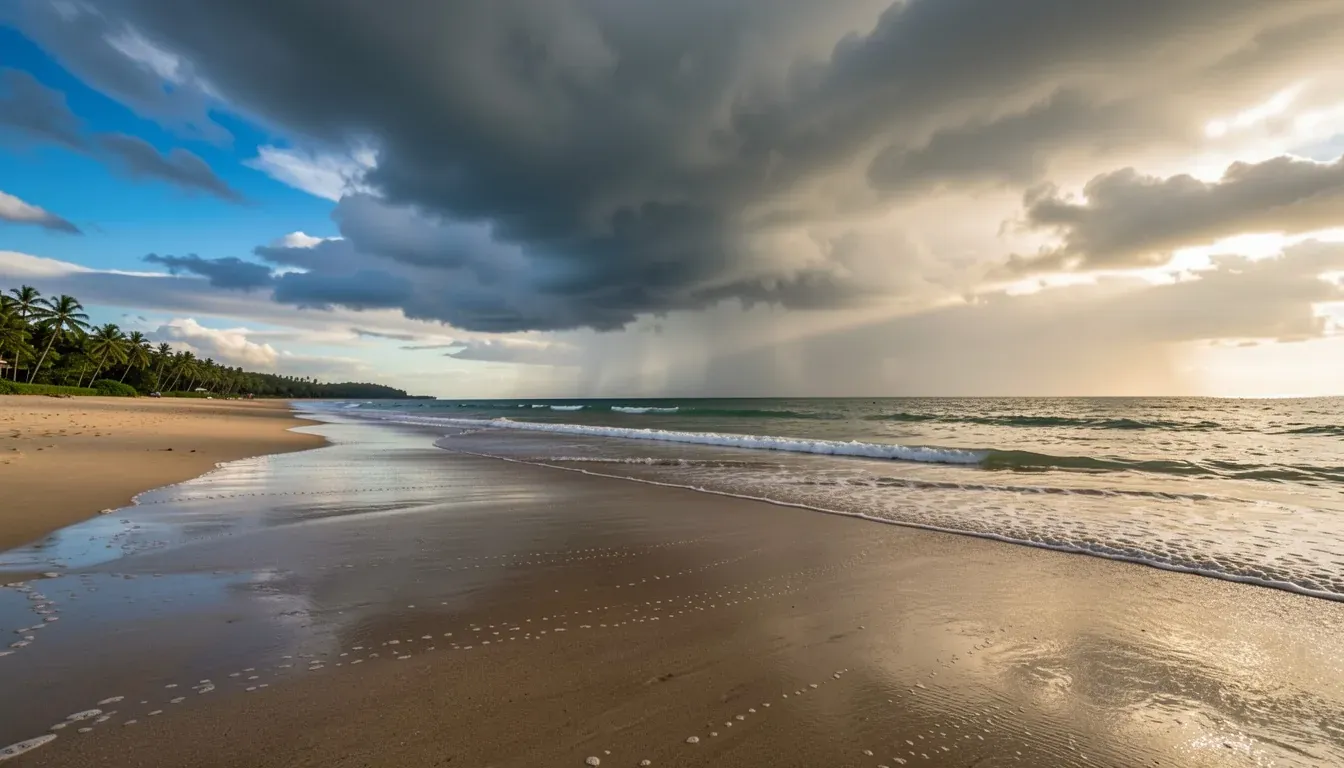
The driest months on Koh Samui are February and April, and rain stays moderate from January to September. The wettest month is November, followed by October and December. Samui sits on the Gulf of Thailand, so its wet season arrives later than on the Andaman coast around Phuket, where the heaviest rain comes in September. This page uses the rainfall normals for the island itself, and says plainly what they do not tell you.
If you are planning a retreat, the weather matters in a few practical ways: whether an open-air shala is pleasant, whether the beach is usable, and how busy the island will be. For the wider picture of the island, start at the Koh Samui guide.
What the rainfall figures show
The best figures we found are the 1991 to 2020 rainfall normals for Koh Samui from the World Meteorological Organization table, as shown on Wikipedia and read on 14 November 2026. They are monthly averages in millimetres.
| Month | Rainfall (mm) |
|---|---|
| January | 126.8 |
| February | 64.3 |
| March | 115.8 |
| April | 82.9 |
| May | 131.6 |
| June | 133.6 |
| July | 117.0 |
| August | 102.2 |
| September | 117.5 |
| October | 294.9 |
| November | 444.6 |
| December | 263.1 |
The year totals 1,994 mm. November alone brings more than a fifth of that. From January to September no month passes 135 mm, while October, November and December each pass 260 mm. February, at 64.3 mm, is the driest month, and April is the next driest at 82.9 mm.
Two cautions. A monthly average hides how rain actually falls: a month can bring a few heavy days or many light ones, and the table cannot tell you which. And these are rainfall normals only. We did not find a temperature, humidity or sea-condition table that we could read and cite, so this page does not give temperature figures and does not draw on a first-hand weather record.
The seasons in plain terms
October to December: the wet months. This is the heavy-rain stretch, and November is the wettest month by a wide margin. Travel-company guides we read on 14 November 2026 also put the Gulf wet season at October to December, which agrees with the table. If you travel then, ask your venue what happens to classes in heavy rain, and whether the shala is open-sided. Check the venue's own cancellation terms before you pay a deposit.
January to April: the drier months. Rainfall is lower from January to April than in the last quarter of the year, with February the driest and April next. January (126.8 mm) and March (115.8 mm) are wetter than February and April, but still well below October. Searches for the island peak in January and February, so book earlier.
May to September: the middle of the year. Rainfall stays between about 100 and 135 mm a month, so these are not the heavy-rain months on this coast. The searching data below suggests fewer people plan retreats at this time, which can mean a quieter course.
When people visit and plan
Search data gives a second view, which measures interest rather than rainfall. Using Ubersuggest figures read on 14 and 15 November 2026:
- Searches for "samui weather" and "wetter koh samui" (the German phrasing) are each about 40,500 a month worldwide. "Best time to visit samui" is about 6,600 a month, "koh samui rainy season" and "koh samui weather by month" about 1,600 each, and "koh samui dry season" about 320.
- Searches for "koh samui" from the UK sat at about 49,500 a month for most of the year to September 2026, rising to 90,500 in January 2026 and dipping to 40,500 in September 2026.
- Germany is the largest European market we measured for "koh samui", at 90,500 a month in November 2025, with a peak of 135,000 in January 2026.
The January peak fits with people planning winter trips. It does not prove the island is crowded then, since we found no arrivals data for Samui by month. Provincial figures exist (Surat Thani, which includes Samui, Phangan and Tao, had 4,361,974 foreign visitors in 2025), but there is no official island split.
For retreat searches specifically, "yoga retreat Thailand" was highest in September and October 2025 and January 2026 (5,400 a month) and lowest from May to July 2026 (2,400 a month). Yoga teacher training is the most seasonal, at 5,400 searches in November 2025 against 1,300 a month from May to October 2026. That is the whole of Thailand, not Samui alone, but it shows when people plan.
Which month should you pick?
- For the driest weather: February, then April. Book ahead.
- For fewer retreat searches and moderate rain: May to September, remembering that rainfall stays near 100 to 135 mm a month.
- For the wettest weather: November, which is the heaviest month by a wide margin. If you must travel then, choose a venue with indoor space.
- For teacher training: courses are advertised all year, but searches fall sharply from May to October. Check the dates with the school. See yoga teacher training on Koh Samui.
If you are comparing the two islands, remember that they share the same sea and the same wet season. See Koh Phangan or Koh Samui and the Koh Phangan weather page, which uses the Samui normals as a stand-in. For a retreat, your choice of area matters as much as the month, so read where to stay on Koh Samui. Flights and ferries are on getting to Koh Samui.
What we could not find
We could not find temperature, humidity, sunshine-hour or sea-condition data for Samui that we could read and cite, so we have not used any. We also have no month-by-month visitor numbers for the island. Month-by-month pages are not yet part of this guide.
FAQs
When is the rainy season on Koh Samui?
The wettest months are October, November and December, with November the peak at 444.6 mm in the 1991 to 2020 normals.
What is the driest month on Koh Samui?
February, at 64.3 mm in the same normals. April is the next driest at 82.9 mm.
Is August a good time to visit Koh Samui?
August averages 102.2 mm of rain, far below October to December. It is also a lower season for retreat searches, so it may be quieter.
Is Koh Samui wet when Phuket is dry?
The two coasts peak at different times. Phuket's wettest month is September, at 349.7 mm in 30-year Thai Meteorological Department averages, while Samui peaks in November.
Related reading
- Koh Samui: how to get there How to reach Koh Samui by flight or by ferry from the mainland, Koh Phangan and Koh Tao, with fares and times read in November 2026.
- Koh Samui: where to stay Where to stay on Koh Samui for a retreat or yoga trip: the main areas, room types at venues we checked, and what to ask first.
More in Koh Samui: retreats, wellness and travel guide
- Detox and fasting retreats in Koh Samui Detox retreats on Koh Samui compared: Health Oasis, Vikasa and New Body & Mind, with dated prices, what is unconfirmed and what to ask before you book.
- All retreats in Koh Samui Every retreat type we have checked on Koh Samui: meditation, detox, yoga and teacher training, with dated prices and what is unconfirmed.
- Yoga classes and studios in Koh Samui Drop-in yoga classes and studios on Koh Samui, with dated prices where we found them and an honest note on listings we could not confirm.
- Yoga retreats in Koh Samui Yoga retreats on Koh Samui compared, with dated prices where venues or listings publish them and the points to check before you book.
- Yoga teacher training in Koh Samui Yoga teacher training on Koh Samui compared, with dated prices where schools publish them and the checks to make before you pay a deposit.
- Samahita Retreat, Koh Samui Beachfront yoga and wellbeing centre on Samui's south coast, open since 2003, with all-inclusive stays, guest-teacher retreats and teacher trainings.
- Vikasa Yoga Retreat, Koh Samui Cliff-side yoga retreat between Chaweng Noi and Lamai with teacher trainings, flexible Vikation stays from USD 700 a week and week-long wellness programmes.